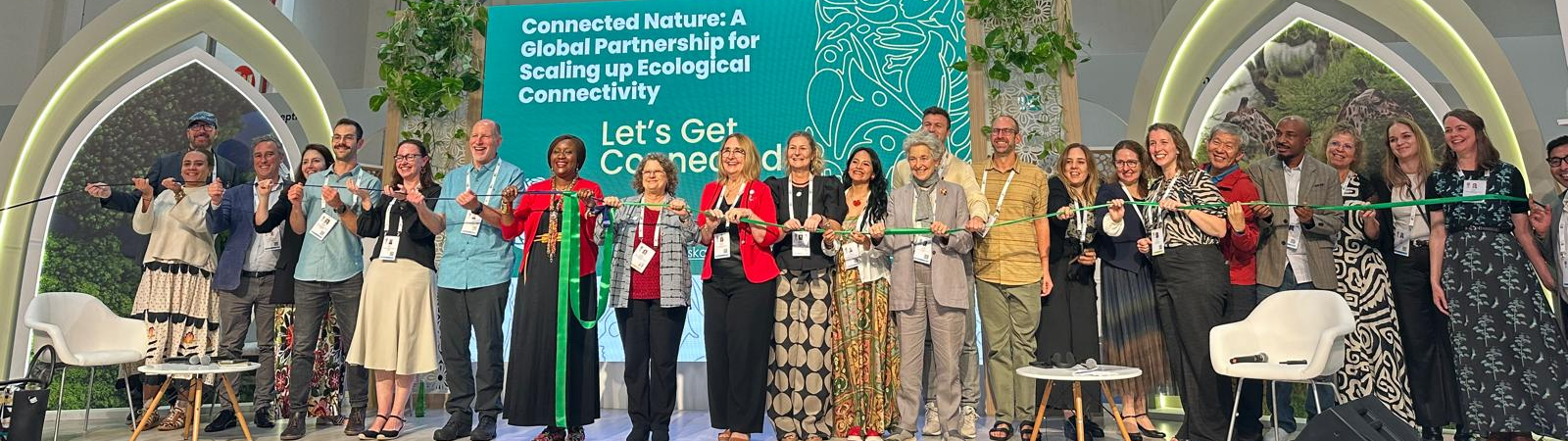
Recognizing that cooperation and collaboration across multiple stakeholders, sectors and national boundaries is essential to scale up connectivity action, the Convention on the Conservation of Migratory Species of Wild Animals (CMS), together with key international organizations, launched the Global Partnership on Ecological Connectivity (GPEC) at its 14th Meeting of the Conference of the Parties (COP 14) in Samarkand, Uzbekistan in 2024.
The Global Partnership on Ecological Connectivity is a multistakeholder network of organizations, institutions and initiatives that facilitates, promotes and implements collective coherent action to maintain, enhance and restore ecological connectivity for the benefit of nature and people across the globe.
Why do we need a partnership for connectivity?
Global efforts and capacity for addressing ecological connectivity on-the ground is both limited and fragmented. There is a need therefore, to scale up support and action in this regard. This partnership approach is particularly important because efforts to conserve ecological connectivity are already underway in many countries and through the activities of numerous international, national, technical and policy organizations.
What do we do?
The Partnership provides a collaborative platform for knowledge and information exchange, supports the development of coherent and effective approaches for scaling up on-the-ground connectivity action, offers technical and policy support, and helps identify priorities for mobilizing funding and activities on the ground.
How do we work?
The Partnership comprises a Steering Committee that oversees the strategic direction and functioning of GPEC and Collaborative Partners. Collaborative Partners are organizations, institutions and initiatives actively engaged in advancing connectivity through on-the-ground action across terrestrial, inland waters, and marine and coastal ecosystems, and who support the delivery of the collective GPEC priorities under the four core areas of the Partnership: Data, Research & Knowledge; Policy & Legislation; Uptake & Implementation and; Awareness &Outreach.
Steering Committee
Steering Committee members are the founding organizations of GPEC that provide oversight and strategic direction to the Partnership and also contribute directly to the implementation of activities as collaborative partners.

CMS is the only global convention specializing in the conservation of migratory species, their habitats and migration routes. CMS brings together the States through which migratory animals pass, the Range States, and lays the legal foundation for internationally coordinated conservation measures throughout a migratory range. Migratory species threatened with extinction are listed on Appendix I of the Convention, with species that need or would significantly benefit from international co-operation listed in Appendix II of the Convention. CMS acts as a framework Convention encouraging Range States to conclude global or regional agreements. Ecological connectivity is essential for the survival of migratory species and is a cross-cutting theme across all of CMS’s work.
The CMS Secretariat is the Convention’s coordinating body, provided and administered by the United Nations Environment Programme (UNEP). The CMS Secretariat is the current chair of the GPEC steering committee.
The Center for Large Landscape Conservation advances ecological connectivity for climate resilience worldwide through science, policy, practice, and collaboration. With a network of partners on six continents, CLLC develops science, crafts policy, supports planning, and informs on-the-ground implementation to address a host of environmental challenges and deploy proven solutions that can be scaled and adapted for diverse locations.

Established in 2016 under the IUCN World Commission on Protected Areas, the Connectivity Conservation Specialist Group is composed of volunteer members from around the world. Members are experts working in government, scientific, academic, non-profit, and business sectors. CCG’s purpose is to serve as the global hub providing scientific, policy and technical advice that mainstreams connectivity conservation as a nature-based solution to enhance the integrity of protected areas, save biodiversity, and increase resilience to climate change across terrestrial, freshwater, and marine ecosystems.
A global centre of excellence on biodiversity and nature’s contribution to society and the economy. UNEP-WCMC works at the interface of science, policy, and practice to tackle the global crisis facing nature and support the transition to a sustainable future for people and the planet.
Tackling the most urgent global conservation challenges though on-the-ground and global policy action, WWF international is an independent global conservation organization, formed in 1961 and committed to building a future where people and nature thrive. Aiming to stop the degradation of the planet’s natural environment and to build a future in which humans live in harmony with nature, WWF international is active through local leadership in over 100 countries.
Collaborative Partners
Collaborative Partners are organizations, institutions and initiatives responsible for executing or contributing to specific areas of work or projects agreed under the Partnership. Any global, regional or national organization, institution or initiative working on activities that support the delivery of the one or more collective priorities of GPEC, can become a Collaborative Partner.
Current Collaborative Partners of the Global Partnership on Ecological Connectivity




Donors
The importance of ecological connectivity and the work of the GPEC has been recognized by numerous donors, who have provided generous support to the GPEC.
We gratefully acknowledge the financial support of all our Connectivity Contributors, without which the work of GPEC would not be possible:
Government of Flanders
Office français de la biodiversité

Monaco
Uzebkistan

Switzerland